
Hospitals don’t have a revenue cycle technology problem. They have an operating model problem.
The number that should reset the conversation is this: initial claim denial rates reached approximately 11.8% by 2024, driven by growing payer complexity, according to Grand View Research’s AI in revenue cycle management market analysis. If your organization is still trying to manage that environment with disconnected work queues, manual status checks, and staff heroics, you’re not running a modern revenue cycle. You’re managing a growing exception factory.
That’s why autonomous end-to-end revenue cycle management matters now. Not because AI is fashionable. Because the old model can’t keep pace with payer rule volatility, staffing pressure, and the CFO’s mandate to protect margin without adding administrative bloat.
The mistake I see most often is treating autonomous RCM as a software feature set. It’s not. It’s a redesign of how work gets done across patient access, coding, claims, denials, posting, and patient financial follow-up. The winners won’t be the health systems that buy the most tools. They’ll be the ones that build a disciplined, governed, hybrid model where automation handles routine decisions and people focus on high-risk exceptions, compliance oversight, and strategic intervention.
Why the Traditional Revenue Cycle Management is No Longer Sustainable
Every percentage point of avoidable revenue leakage hits the same place: margin, cash, and confidence in the forecast.
Traditional RCM fails because it was built for a slower payer environment and a more stable labor model. That environment is gone. Front-end errors still enter through registration, eligibility, and prior authorization. Documentation gaps still disrupt coding and charge capture. Denials teams still spend expensive labor fixing defects after the claim has already missed its clean path to payment. The difference now is volume, speed, and complexity. The old operating model cannot absorb all three.
As noted earlier, initial denial rates climbed to roughly 11.8% in 2024. For a CFO, that is not a staffing inconvenience. It is a structural warning that the current model is producing too much rework to sustain.
Why incremental fixes fail
Many health systems have already squeezed the obvious process gains out of the revenue cycle. They added claim edits. They created escalation paths. They deployed point automations for status checks or remittance posting. Some outsourced pieces of the workflow. Yet days in A/R stay stubborn, preventable denials keep returning, and managers still depend on work queues to discover what went wrong.
That happens because the workflow is still fragmented.
A defect that starts at intake can move through coding, billing, denials, appeals, and patient collections before anyone addresses the root cause. By then, the organization has paid for the same claim several times in labor, delayed cash, and raised audit exposure.
Three business problems follow:
- Rework grows faster than volume because one bad input creates multiple downstream touches across teams.
- Cash arrives later because intervention starts after a payer reject, pend, or underpayment instead of before submission.
- Compliance gets harder to control because disconnected systems and handoffs weaken documentation, consistency, and auditability.
Practical rule: If your team spends more time correcting claims than preventing defects, your revenue cycle is organized around rework, not yield.
The strategic response
Hospital finance leaders should treat autonomous end-to-end RCM as an operating model change, not another software purchase. The goal is to redesign how the revenue cycle makes routine decisions, routes work, and manages exceptions across the full claim lifecycle. That changes the economics of the function. Staff stop acting as human middleware between disconnected systems and start focusing on exceptions, payer strategy, and compliance oversight.
The cost of staying manual is now higher than the cost of redesigning. Every manual handoff adds delay. Every delayed correction raises collection risk. Every inconsistent workflow makes it harder to defend performance to the board, auditors, and clinical leadership.
RCM is no longer a labor-scaling exercise. It is a control system for margin. Health systems that keep running it like a back-office queue management problem will keep losing cash to avoidable friction.
What Is Autonomous End-to-End RCM Really
Most organizations confuse automation with autonomy. They’re not the same thing.
Basic automation is cruise control. It can keep the car moving at a set speed on a predictable road. Autonomous end-to-end revenue cycle management is closer to self-driving capability. It senses conditions, makes context-aware decisions, coordinates multiple actions, and adapts when the route changes.
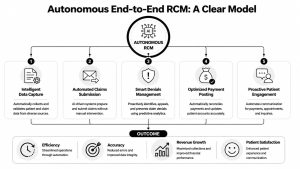
The difference between bots and intelligent orchestration
Traditional robotic process automation (RPA) is useful, but limited. It follows scripts. It handles known, repetitive scenarios. Once the workflow changes, the bot stalls or hands the task back to a person.
By contrast, agentic AI in autonomous RCM uses self-orchestrating intelligent agents that manage claims, denials, and authorizations by learning in real time and handling multi-step processes without constant human handoffs.
That distinction matters because revenue cycle work is rarely linear. Eligibility affects authorization. Authorization affects coding confidence. Coding affects claim acceptance. Claim status affects denial prevention and payment posting. If each function operates in a silo, automation only speeds up fragments. It doesn’t improve the whole.
What end-to-end actually means
End-to-end means the platform or operating model connects the major revenue cycle domains into a single managed flow:
- Front-end patient access with eligibility, benefit validation, and authorization support
- Mid-cycle integrity with coding, documentation review, and claim preparation
- Back-end performance with denial prevention, payment reconciliation, underpayment review, and patient balance follow-up
That’s why I don’t advise CFOs to ask vendors, “Do you have AI?” That’s the wrong question. Ask whether the system can coordinate decisions across these domains without creating more handoffs.
The real value isn’t faster task execution. It’s fewer avoidable decisions reaching a human workqueue in the first place.
The operating model shift
A mature autonomous RCM model behaves like a control tower. It pulls data from clinical, financial, and payer-facing workflows. It validates information before submission. It routes exceptions based on risk. It learns from denial patterns. And it feeds those lessons back into upstream processes so the same defect doesn’t keep recurring.
That’s why this isn’t just a technical architecture. It’s an operational redesign. Leadership has to decide where automation should act independently, where staff should review, and how accountability will work when workflows span departments instead of sitting inside narrow functional silos.
How AI and Automation Power the RCM Flywheel
The best way to understand the technology stack is to stop thinking about tools and start thinking about jobs to be done. In a high-performing revenue cycle, each technology should remove a specific category of friction. Together, they create a flywheel: cleaner inputs lead to cleaner claims, cleaner claims lead to fewer denials, fewer denials free staff capacity, and that capacity goes toward the exceptions that need judgment.

What each technology actually does
AI makes decisions inside the workflow. It can evaluate patient and claim data, compare it to payer-specific logic, and determine the next best action. In practical terms, that means flagging missing documentation, identifying mismatches before submission, and routing cases by priority.
Machine learning improves pattern recognition over time. It’s most valuable in denial prediction, payment variance analysis, and prioritization. When the model learns which accounts are most likely to fail or delay, your team can intervene earlier.
Natural language processing turns clinical documentation into structured revenue cycle intelligence. It reads unstructured notes and supports coding, documentation review, and the creation of an auditable rationale for action.
RPA handles repetitive system tasks. It logs into payer portals, gathers claim status, moves data between systems, and completes the manual swivel-chair work that drains productivity.
For a practical overview of where these capabilities are already changing operations, GeBBS offers a useful perspective in how AI is transforming healthcare revenue cycle management.
Why coordination matters more than any one tool
The mistake is deploying these tools independently. A standalone bot may save time. A standalone model may generate risk scores. But if they don’t operate in a coordinated workflow, your staff still has to reconcile the outputs manually.
A better model looks like this:
- Capture and validate data early so bad information doesn’t contaminate the claim.
- Translate documentation into coding and billing intelligence without waiting for retrospective cleanup.
- Predict failure points before submission and resolve them upstream.
- Automate repetitive payer interactions so human effort goes to actual exception handling.
- Feed outcomes back into the workflow so the process gets smarter over time.
The flywheel effect executives should care about
When these components work together, you don’t just get task automation. You get operational compounding. Fewer front-end errors produce cleaner downstream activity. Cleaner downstream activity reduces denial volume. Lower denial volume gives specialists time to focus on complex appeals, underpayments, and high-value accounts.
A good autonomous RCM program doesn’t replace your best people. It protects their time from low-value work.
That’s the executive lens to use. If the technology can’t reduce handoffs, compress cycle time, and improve control across the full process, it’s just digitized fragmentation.
Quantifying the Impact on Your Bottom Line
CFOs should judge autonomous end-to-end revenue cycle management the same way they judge any major operating model change. By its effect on denials, cash, and revenue integrity. If a vendor can’t connect its approach to those three outcomes, the pitch isn’t mature enough.

Denial reduction is the first source of value
Denials are expensive because they combine lost time, delayed cash, and preventable write-off risk. Mid-cycle automation has a direct impact here. Denial management starts upstream, where coding, documentation, and claim quality are still controllable.
What that means operationally
- Cleaner claims at first submission reduce avoidable payer friction.
- Faster billing cycles accelerate the handoff from clinical completion to cash generation.
- Higher coding accuracy protects both reimbursement and audit defensibility.
Cash acceleration matters as much as margin
A denial avoided is better than a denial appealed. But cash acceleration goes further than denials alone. Autonomous workflows shrink the lag between service, claim creation, submission, adjudication, and posting. They also reduce the time staff spend waiting on information trapped in different systems or payer channels.
Here’s a concise visual explainer on the business case:
For a CFO, this translates into more predictable collections and less operational drag between earned revenue and posted cash. That predictability is valuable even before you quantify every downstream effect, because it strengthens forecasting and reduces dependence on late-cycle recovery.
Revenue integrity is where the upside compounds
Many organizations evaluate RCM automation too narrowly. They focus on labor savings and miss the larger opportunity. Better coding, stronger documentation alignment, and earlier defect detection protect earned revenue that never should have leaked out in the first place.
Board-level takeaway: The strongest autonomous RCM business case combines cost avoidance with revenue preservation. If you measure only staffing efficiency, you’ll undervalue the investment.
A disciplined ROI model should track three buckets together:
| Financial pillar | What to measure | Why it matters |
| Denial performance | Denial rate, preventable denial categories, appeal burden | Shows whether the system is preventing rework |
| Cash movement | Billing cycle speed, claim turnaround, payment posting timeliness | Shows whether revenue is reaching the bank faster |
| Revenue integrity | Coding accuracy, documentation alignment, missed charge trends | Shows whether earned reimbursement is protected |
If your current business case ignores one of these buckets, rebuild it. Autonomous RCM earns its keep when all three move together.
Building Your Roadmap for Autonomous RCM Adoption
Most autonomous RCM programs fail for a simple reason. Leaders try to automate chaos. If your workflows are inconsistent, your rules are undocumented, and your data is fragmented, AI will expose those weaknesses faster than manual operations ever did.
That’s why adoption needs a roadmap, not a launch date.

Start with the 80 20 reality
You’re not going to automate every revenue cycle decision. And you shouldn’t try. Organizations can realistically automate about 80% of revenue cycle tasks, while the remaining 20% requires human intervention, according to TechTarget’s analysis of agentic AI and autonomous revenue cycle evolution.
That’s not a limitation. It’s a design principle.
The right goal is to automate high-volume, rules-driven work and reserve human judgment for compliance-sensitive, clinically nuanced, or financially material exceptions. Health systems that accept this early make better decisions about staffing, governance, and vendor scope.
A practical adoption sequence
I recommend a phased model.
- Stabilize the data layer
Clean up interfaces, standardize source systems where possible, and define who owns core revenue cycle data elements. If eligibility, coding, claims, and remits all tell a different story, autonomy won’t scale. - Pick one high-friction use case
Start where pain is visible and measurable. Denial-prone workflows, claim creation and scrubbing, or payment posting exceptions are good candidates. - Define the human-in-the-loop model
Decide which tasks the system can complete autonomously, which require approval, and which always route to staff. - Retrain roles, don’t just redeploy labor
Your best people should move into exception management, payer escalation, QA, and automation oversight.
A strong overview of the foundational work behind this transition appears in this GeBBS discussion of data modernization, interoperability, and expert partnerships in automated RCM.
Build governance before scale
Autonomy without governance creates new risk. Put a steering model in place early, with finance, revenue cycle, compliance, IT, and operational leadership all accountable for outcomes.
Use a governance checklist like this:
- Decision rights for workflow changes, model thresholds, and exception routing
- Audit standards for coding logic, edits, overrides, and appeal actions
- Escalation paths when payer behavior changes or the model starts drifting
- Workforce metrics that track not just productivity, but exception quality and turnaround
Don’t ask whether the organization is ready for full autonomy. Ask whether it’s ready to govern a hybrid workforce where machines do the routine work and people own the exceptions.
That question leads to better implementation decisions.
Choosing the Right Partner and Defining Success
Many health systems get distracted by demos. You are not buying software. You are selecting a partner to help redesign a mission-critical financial operation.
That distinction matters because technology alone rarely solves RCM performance problems. The organizations that scale fastest usually combine platform capability with operational expertise, governance discipline, and deep integration support. That’s one reason outsourcing services hold a 60% market share in the broader RCM market, and why top-quartile providers achieve collection rates exceeding 98%, according to MarketsandMarkets research on the RCM market.
What to evaluate beyond the demo
A polished user interface doesn’t tell you whether the partner can manage payer complexity, maintain controls, or stand up workflows across your actual environment. Evaluate the operating model, not just the screens.
| Criterion | Description | Why It Matters for Health Systems |
| Data integration capability | Ability to connect EHR, clearinghouse, remit, patient access, and coding workflows into a unified operating model | Fragmented data kills autonomy and creates manual reconciliation |
| Workflow orchestration | Capacity to manage end-to-end tasks across patient access, claims, denials, and posting | Point automation speeds fragments but doesn’t improve enterprise performance |
| Compliance and auditability | Clear audit trails, role-based controls, and defensible workflow logic | CFOs and compliance leaders need transparency, not black-box decisions |
| Service model maturity | Availability of operational support, exception handling, and continuous optimization | Most organizations need more than software to deliver sustainable outcomes |
| Change management support | Training, governance setup, and workforce redesign assistance | Adoption fails when teams aren’t prepared for new roles and accountabilities |
| Outcome alignment | Willingness to define success with shared operational and financial metrics | The relationship should be built around measurable performance, not activity |
The KPIs that actually matter
Too many implementations drown in vanity metrics. A hospital CFO needs a narrower set of indicators that connect directly to financial performance and control.
Focus on measures such as:
- Cost to collect because this shows whether the operating model is becoming more efficient
- Clean claim performance because first-pass quality predicts downstream friction
- AR days and collection velocity because speed to cash is a strategic outcome, not a side effect
- Denial rate by root cause because aggregate denial numbers hide where process defects begin
- Exception volume by workflow stage because that tells you whether autonomy is really reducing manual touchpoints
The partner test I use
Ask every finalist the same hard questions:
- Which workflows can your platform complete without human intervention?
- Which workflows should remain human-controlled in a hospital setting?
- How do you prove auditability for coding, edits, and appeals?
- What governance cadence do you recommend after go-live?
- How do you handle payer behavior changes without creating operational disruption?
If a vendor promises total autonomy with little discussion of governance, controls, or exception management, walk away.
The strongest partner won’t sell magic. They’ll show you how to run a better revenue cycle.
Navigating Compliance and Future-Proofing Your Strategy
A lot of executives still frame autonomous RCM as a compliance risk. That’s backward. Poorly controlled manual work is often the larger risk. Spreadsheets, inconsistent edits, undocumented overrides, and fragmented staff handoffs create weak auditability. A mature autonomous model can improve control because it standardizes execution and records decisions.
Compliance should be designed into the workflow
The right standard isn’t “Does the platform use AI?” The right standard is “Can the organization explain what happened, why it happened, and who approved exceptions?” In healthcare revenue cycle operations, that’s the true measure.
That means your future-state model needs:
- Auditable decision trails for coding, edits, claims actions, and payment reconciliation
- Role-based controls that limit who can override workflows or modify rules
- Documented governance for exception handling and policy updates
- Security and privacy discipline across every handoff involving protected health information
For organizations reviewing privacy controls in parallel with automation strategy, GeBBS provides a useful resource on how to ensure HIPAA compliance in RCM processes.
Future-proofing is really about operating leverage
The long-term case for autonomous end-to-end revenue cycle management isn’t just efficiency. It’s resilience. Health systems need an RCM model that can absorb payer rule shifts, support value-based reimbursement, and scale without matching every new challenge with more headcount.
That only happens when revenue integrity becomes systematic. Better data continuity across the revenue cycle supports cleaner documentation, more consistent coding, stronger payment accuracy, and faster response to changing payer requirements. Those capabilities matter now, and they’ll matter even more as reimbursement models keep getting more complex.
The organizations that delay this shift will keep treating symptoms. They’ll work denials harder, add more edits, create more workqueues, and hire more people to manage preventable variation. The organizations that move now will build a controlled hybrid model that makes human expertise more valuable, not less.
Autonomous RCM isn’t a moonshot. It’s the next practical operating model for hospitals that want stronger cash performance, tighter compliance, and a revenue cycle built to hold up under pressure.
GeBBS Healthcare Solutions helps hospitals and health systems modernize revenue operations with technology-enabled RCM, AI-driven coding and denial prevention, automation, analytics, and expert service delivery. If you’re evaluating autonomous end-to-end revenue cycle management and want a partner that can support both performance and governance, visit GeBBS Healthcare Solutions.